What the City collects after a storm
The City of Fort Lauderdale's storm debris guidance is specific: only loose debris is collected, and it must be separated into piles on the swale — vegetation (trees, branches, limbs), construction debris (wood, fencing, drywall, glass, metal, roofing, tile, furnishings, fixtures), appliances (fridges, ovens, freezers, A/C units, washers, dryers, water heaters) and electronics (computers, TVs, office equipment). Failure to separate delays removal. Bagged debris cannot be collected, and household hazardous waste — paints, cleaners, pesticides — must not be put out at all. The City's customer service line is 954-828-8000; its storm debris page and "Storm Debris Clean-Up" flyer are the source for all of this.
Plantation publishes the same approach — vegetative, construction, white goods, e-goods and household garbage in separate piles on the swale, never in the street or over storm drains — and notes that HOAs and private roads may need their own contractor.
What falls outside the City program
- Timing. City collection runs on the City's schedule, which after a big storm can take weeks. A container is on your driveway the week it happens.
- Bagged and mixed debris. The City will not take it; a container does not care.
- Contractor-generated debris. Normal bulk service in Fort Lauderdale is monthly, capped at 10 cubic yards, and excludes dirt, sand, pavers, concrete and tile. A roof that a contractor stripped after the storm is container work.
- Private roads and HOA communities may be outside the City's route entirely.
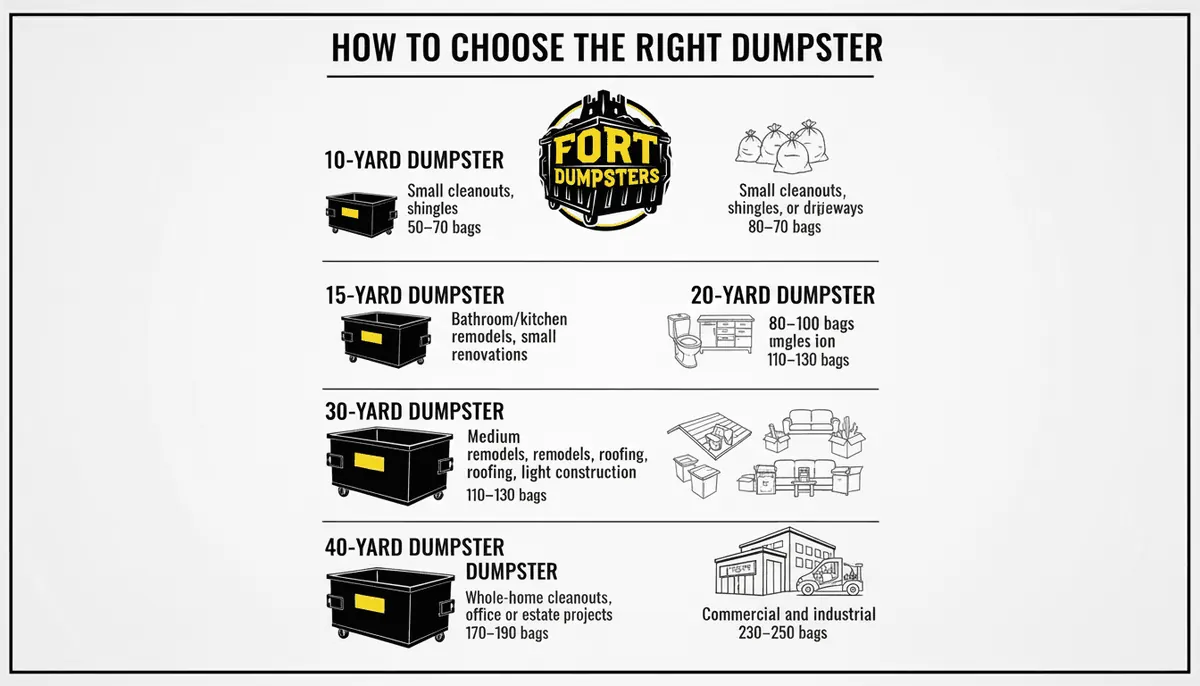
- Commercial properties. Fences, furnishings and fixtures from several buildings at once is a 30 or 40 yard job on a lot.
How to use a container after a storm
- Call early. Demand spikes for weeks after a hurricane; we serve in the order calls come in and tell you honestly where you are in the queue.
- Separate green from construction. Fronds, branches and stumps in one container go for recovery at the lower yard-trash rate; fencing, screen-enclosure frames and roofing in another. Mixed is fine if that is what you have.
- Keep the hazardous stuff out. Propane tanks, pool chemicals, fuel, batteries and paint go to a County or City hazardous-waste drop-off, not the box.
- Refrigerant appliances aside. A flooded fridge or A/C unit is handled separately — tell us.
- Keep it on the driveway. After a storm the swale is where the City wants its own piles, and a right-of-way placement still needs the City Engineer's permit.
Before the storm: empty containers and high wind
If a hurricane warning is issued while one of our containers is on your property, call us. An empty roll-off in hurricane-force wind is a hazard, and we would rather collect it before the storm and bring it back after. Several Broward cities require portable storage units to be removed on a hurricane warning for the same reason.
Where the debris goes
The Broward County Landfill accepts bulk waste, yard trash and construction and demolition debris from within the county — $100 a ton for construction material and bulk, $75 a ton for yard trash, from 1 January 2026 — which is why keeping vegetation separate saves money. Clean metal from fencing and enclosures goes for recovery.